TL;DR:
- Apple repair expertise involves advanced skills in board-level microsoldering, parts pairing, and handling secure hardware encryption. It is crucial for successful data recovery because Apple’s hardware encrypts storage and ties components to specific hardware configurations, making unauthorized repairs likely to cause permanent data loss. Only shops with direct experience in forensic recovery and in-house repair capabilities can reliably recover data from encrypted Apple devices.
Apple expertise in repair shops is defined as the specialized technical knowledge required to correctly diagnose, repair, and recover data from Apple devices that use proprietary hardware, firmware, and encryption systems unavailable to general repair technicians. This goes far beyond swapping screens or replacing batteries. Apple’s T2 chip, Apple Silicon architecture, APFS file system, and parts-pairing software create a repair environment where generic skills produce failed repairs and, in the worst cases, permanent data loss. Since 2006, Macwestlosangeles has built its practice around exactly these specialized capabilities, serving clients across West LA, Santa Monica, and Beverly Hills who need more than a standard fix.
What specialized skills define Apple repair expertise?
Board-level microsoldering is the foundation of genuine Apple repair expertise. Apple logic boards use densely packed components with traces finer than a human hair, and repairing them requires precision tools, a steady hand, and deep knowledge of Apple-specific circuit architecture. Independent repair technicians often match or exceed Apple’s own certified staff in board-level skills, including former Apple employees who now work in independent shops.
Software calibration is the second pillar. Apple requires new parts to be paired with the device using proprietary software tied to the device’s serial number. Parts pairing and calibration software links components to specific hardware, meaning a physically perfect repair can still fail without the right tools. A technician who understands this distinction saves clients from repeat visits and wasted money.
Security hardware and firmware knowledge round out the skill set. Apple’s T2 and Apple Silicon chips handle secure boot sequences and storage encryption at the hardware level. A technician without this knowledge cannot safely access or restore a device without risking data corruption or a bricked machine.
The core skills that separate Apple repair experts from general technicians include:
- Board-level microsoldering: Repairing logic board traces, replacing individual components like charging controllers and power management ICs
- APFS and NVMe familiarity: Understanding Apple’s file system and NVMe SSD architecture for accurate diagnostics
- Parts-pairing navigation: Access to or workarounds for Apple’s proprietary calibration software
- Security chip handling: Safe procedures around T2 and Apple Silicon encryption to avoid data loss
- Genuine parts sourcing: Relationships with verified suppliers, including factory-direct Apple parts outside official channels
Pro Tip: Ask any repair shop whether they perform board-level repairs in-house or send logic boards out. Shops that handle microsoldering on-site have a fundamentally different skill level than those that only swap assemblies.
Why is Apple expertise vital for data recovery?
Data recovery from Apple devices fails most often because of two factors: encryption tied to hardware and damage caused by incorrect repair attempts. Apple’s T2 chip and Apple Silicon integrate storage encryption directly into the logic board, meaning the encryption key is bound to the original hardware. Swapping a storage chip to a different board does not work. The data stays locked unless the original board is functional or the recovery process accounts for this architecture.
The APFS file system adds another layer of complexity. APFS uses copy-on-write metadata, snapshots, and space sharing across volumes. These features improve performance but make recovery from a corrupted or partially overwritten drive significantly harder than recovery from older HFS+ volumes. A technician unfamiliar with APFS structure can run standard recovery software and retrieve nothing useful.
Amateur repair attempts cause more unrecoverable data loss than the original hardware failures. Most unrecoverable data loss results from damage introduced during an incorrect repair, not from the initial failure. This is the most important reason to verify expertise before handing over a device.
Forensic-grade recovery follows a specific sequence:
- Stop all disk writes immediately. Continued use of a failing drive overwrites recoverable data sectors.
- Image the storage. Create a sector-by-sector clone before any repair attempt touches the original media.
- Assess board condition. Identify liquid damage, corrosion, or component failure on the logic board before powering the device.
- Use donor components carefully. Forensic recovery labs use controlled environments and donor parts to minimize stress on failing storage.
- Navigate encryption. Work within the original hardware’s security context to access APFS volumes without triggering FileVault lockouts.
Pro Tip: If your Mac shows signs of liquid damage, do not attempt to charge or power it on. Power cycling a wet logic board causes short circuits that can destroy the very chips holding your encryption keys.
DIY recovery on devices with soldered SSDs and APFS carries a high risk of permanent loss. The combination of hardware encryption and Apple’s proprietary file system makes professional intervention the only reliable path when data matters.
How do Apple’s repair policies affect independent shops?
Apple’s parts-pairing system is the single largest technical barrier for independent repair shops. Even genuine Apple screens installed in M2 MacBook Pros display artifacting until proprietary calibration software completes the pairing process. This means a physically correct repair with a genuine part still produces a defective result without Apple’s tools. The implication is direct: software access now determines repair quality as much as technical skill does.
Apple’s Self Service Repair program offers some parts and manuals to consumers, but it does not provide the calibration software that resolves pairing issues. Independent shops with deep expertise find workarounds, but those workarounds require significant investment in third-party tools and ongoing training.
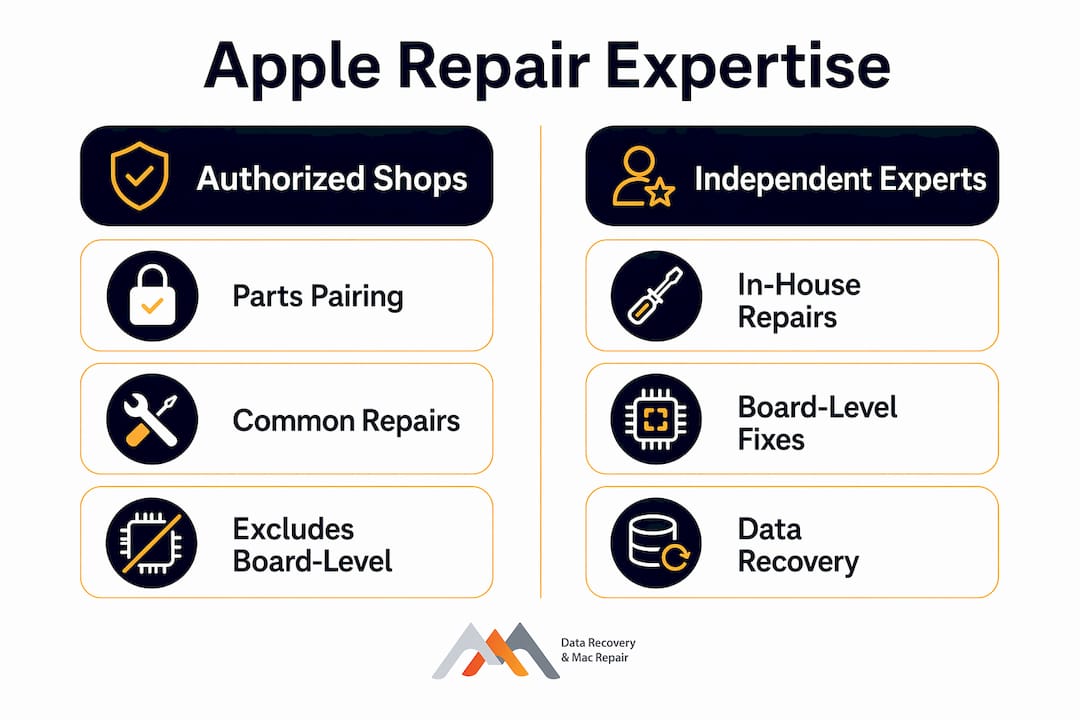
The table below compares how repair policy barriers affect different shop types:
| Factor | Authorized service providers | Independent expert shops |
|---|---|---|
| Parts pairing software access | Full Apple-provided access | Limited; requires third-party tools |
| Board-level repair scope | Often excluded from certification | Commonly performed in-house |
| Complex repairs (e.g., logic board) | Frequently declined | Accepted by experienced shops |
| Genuine parts sourcing | Official Apple supply chain | Factory-direct and verified suppliers |
| Forensic data recovery | Rarely offered | Core service at specialist shops |
Apple certification focuses on common repairs and explicitly excludes complex board-level fixes like charging port replacements and logic board component repairs. Authorized providers often decline these jobs. Independent shops with genuine expertise handle them routinely. The right-to-repair regulatory environment is shifting in favor of independent shops, but the software barrier remains the defining challenge of 2026.
How to find genuine Apple repair experts for reliable service
Identifying a shop with real Apple repair expertise requires asking specific questions, not just checking for a certification badge. Certification tells you a shop can perform common repairs. It does not tell you whether they can recover data from a liquid-damaged MacBook with a T2 chip or resolder a failed power management IC on an M1 logic board.
Use this checklist when evaluating a repair provider:
- Board-level repair capability: Ask directly whether microsoldering is performed on-site. Request examples of logic board repairs they have completed.
- Data recovery process: A credible shop describes a forensic imaging step before any physical repair. If they skip straight to hardware fixes, your data is at risk.
- Transparent pricing policy: Look for a “no recovery, no charge” guarantee. This signals the shop is confident in its process and not billing for failed attempts.
- Free diagnostics: Shops that offer free diagnostics have nothing to hide. It also means you get an honest assessment before committing to a repair.
- Genuine parts sourcing: Ask whether parts come from Apple’s supply chain or verified factory suppliers. Both are acceptable; vague answers are not.
- Customer reviews and tenure: Look for shops operating since at least the mid-2000s. Experience with older Apple architectures, like PowerPC and early Intel logic boards, signals depth of knowledge.
- Same-day appointment availability: Shops with real capacity and organized workflows offer same-day service. Long waits often indicate understaffing or outsourcing.
The Apple repair checklist from Macwestlosangeles provides a practical framework for Mac users in Los Angeles evaluating local repair options. Local expertise matters because data recovery sometimes requires in-person assessment of physical damage that cannot be diagnosed remotely.
Key Takeaways
Apple repair expertise is the single most important factor determining whether a repair succeeds, data is recovered, and no additional damage is introduced during the process.
| Point | Details |
|---|---|
| Board-level skills are non-negotiable | Microsoldering and logic board component repair separate expert shops from assembly-swap operations. |
| Encryption complicates data recovery | T2 and Apple Silicon bind encryption keys to the original logic board, requiring hardware-aware forensic methods. |
| Parts pairing is a software problem | Even genuine Apple parts fail without proprietary calibration tools, making software access as critical as technical skill. |
| Amateur repairs cause permanent loss | Most unrecoverable data loss results from incorrect repair attempts, not the original hardware failure. |
| Certification alone is insufficient | True Apple expertise includes forensic recovery and board-level repair that authorized certification programs often exclude. |
Why Apple expertise is the one thing I would never compromise on
I have seen the same scenario play out more times than I can count. A client brings in a MacBook that had a “simple” repair done somewhere else. The screen was replaced, or a battery was swapped, and somewhere in that process the logic board was stressed, a connector was forced, or the device was powered on while still wet. What started as a recoverable situation became a forensic challenge.
The uncomfortable truth about Apple repair is that the hardware is unforgiving. Apple Silicon and T2 chips do not give you a second chance. Once the encryption key is lost because the wrong chip was damaged during an amateur repair, the data is gone. No software tool recovers it. No amount of time or money changes that outcome.
Authorized certification is a useful baseline, but it is not the ceiling. The best technicians I have encountered combine board-level microsoldering skills with forensic data recovery discipline and a genuine understanding of APFS, NVMe, and Apple’s security architecture. Many of them work in independent shops, not Apple stores. The role of experience in recovery outcomes is measurable and direct.
My advice to anyone evaluating a repair shop: ask about the worst-case scenario before you commit. Ask what happens if the repair goes wrong. A shop with real expertise will walk you through their risk mitigation process without hesitation. A shop without it will change the subject.
— Kaya
Macwestlosangeles: Apple expertise serving West LA since 2006
Macwestlosangeles has provided Mac repair and data recovery in Los Angeles since 2006, with board-level logic board repair, forensic data recovery, and same-day appointments available at 12041 Wilshire Blvd, Ste 26. The shop serves West LA, Santa Monica, Beverly Hills, Brentwood, Westwood, Venice, Hollywood, and Culver City. Free diagnostics are standard on every device, and the “no recovery, no charge” policy applies to all data recovery cases. Whether you are dealing with liquid damage, a failed NVMe SSD, RAID array failure, or an encrypted MacBook that will not boot, the team handles it in-house without outsourcing. Call 310-866-0828 to schedule a same-day appointment or get a free estimate on your data recovery case.
FAQ
What does Apple repair expertise actually mean?
Apple repair expertise means a technician can perform board-level microsoldering, navigate parts-pairing software, handle T2 and Apple Silicon encryption, and execute forensic data recovery. It goes beyond common repairs like screen and battery replacements.
Why can’t a general repair shop recover data from my Mac?
Apple’s T2 chip and Apple Silicon bind storage encryption to the original logic board hardware. A general technician without forensic training and hardware-level Apple knowledge cannot access encrypted APFS volumes or safely image a failing NVMe drive.
Is an Apple authorized service provider always the best choice?
Not necessarily. Apple certification covers common repairs but excludes complex board-level fixes that independent expert shops routinely perform. Evaluate the shop’s specific capabilities, not just its authorization status.
What is parts pairing and why does it matter?
Parts pairing is Apple’s system that links replacement components to a device’s serial number using proprietary software. Without calibration software, even genuine Apple parts can produce defective results after installation.
How do I know if a repair shop is qualified for data recovery?
Ask whether they image the storage before any physical repair, offer a “no recovery, no charge” guarantee, and perform forensic recovery in-house. Shops that skip the imaging step or outsource recovery work are not equipped for serious data loss cases.