TL;DR:
- Mac repair terminology includes specialized words technicians and clients use to describe Apple components, repairs, and standards accurately. Understanding this vocabulary ensures correct diagnosis, cost estimates, and data safety during repairs. Mastery of key terms improves communication and helps prevent costly misunderstandings in the repair process.
Mac repair industry terminology is the specialized vocabulary technicians and clients use to describe Apple Mac components, repair processes, and service standards with precision. Without a shared language, a technician diagnosing a PMIC fault on a logic board and a client expecting a simple battery swap are having two completely different conversations. The Apple repair field uses terms like Apple Authorized Service Provider (AASP), Repair Assistant, Activation Lock, and APFS that carry specific technical weight. Mastering this vocabulary, whether you work the bench or bring in your MacBook, directly affects repair accuracy, cost expectations, and data safety outcomes. Macwestlosangeles has served Los Angeles clients since 2006, and clear terminology remains the foundation of every successful repair.
What are the essential terms used in Mac repair?
Ten core terms cover roughly 80% of diagnostic communication in the Mac repair field. Understanding them gives both technicians and clients a working command of most repair conversations.
- Battery Health: A percentage reported by macOS showing remaining charge capacity relative to the original design capacity. A reading below 80% typically signals the battery needs replacement.
- PMIC (Power Management Integrated Circuit): A chip on the logic board that regulates voltage and power delivery to all components. A failed PMIC often mimics a dead battery, which is why accurate diagnosis matters before ordering parts.
- BoardView: A digital schematic showing every component, trace, and test point on the logic board. Technicians use BoardView files alongside a multimeter to trace faults at the component level.
- Microsoldering: Precision soldering work performed under a microscope on logic board components such as capacitors, resistors, and power ICs. This is a distinct skill set from standard repair work.
- Genuine Apple Part: A component manufactured by Apple or an Apple-approved supplier and verified through Apple’s supply chain. Using non-genuine parts can affect device performance and void service eligibility.
- Repair Assistant: Apple’s software tool that pairs replacement parts, such as displays and batteries, to a specific device. Without it, a genuine display replacement still loses True Tone and may show artifacts.
- Activation Lock: A security feature tied to an Apple ID that prevents unauthorized use of a device. A Mac with Activation Lock enabled cannot be set up or repaired to full functionality without the owner’s Apple ID credentials.
- GPD (Genuine Parts Distributor): An Apple-authorized distributor that supplies certified components to repair providers. Sourcing from a GPD is the clearest way to confirm part authenticity before installation.
- AASP (Apple Authorized Service Provider): A repair business certified by Apple to perform repairs using genuine parts and Apple-approved procedures. AASP status requires ongoing training and audits.
- Parts and Service History: A record visible in macOS System Information showing which components have been replaced and whether they were verified genuine. Clients reviewing a used Mac purchase should always check this section first.
Pro Tip: Before any repair appointment, pull up System Information on your Mac and check the Parts and Service History section. It tells you exactly what has already been replaced and whether those parts were genuine, saving time during the diagnostic conversation.
How do modular and component-level repairs differ?
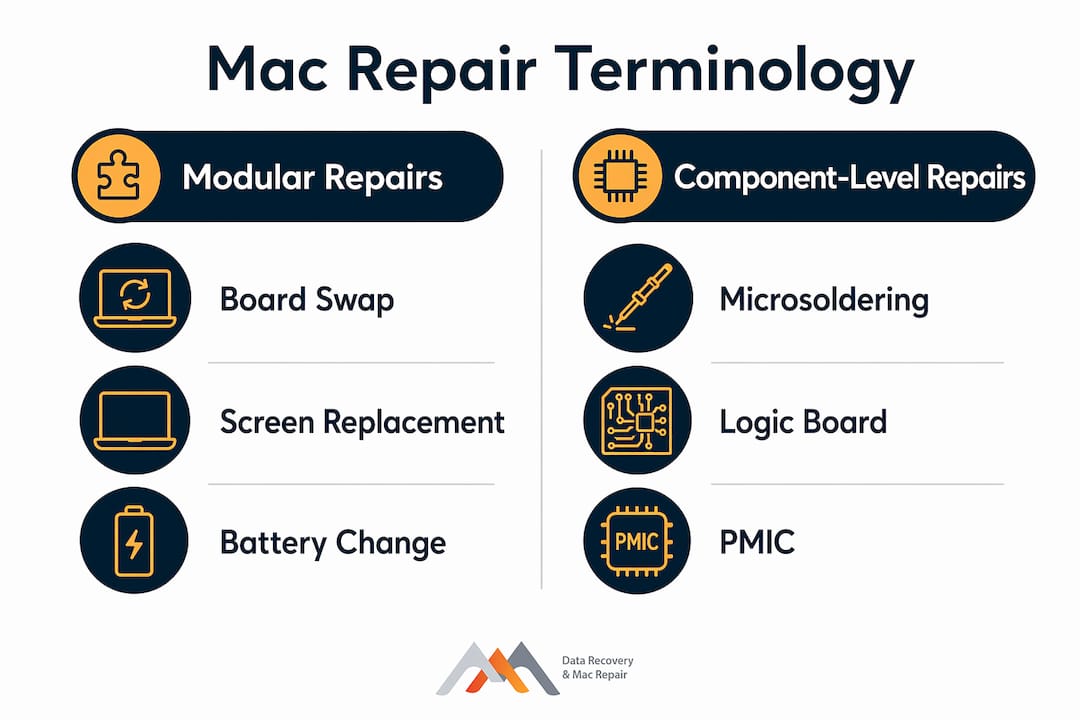
The distinction between modular and component-level repair is the single most important concept in Mac service terminology. Clients who understand this difference set accurate expectations and avoid costly surprises.
Modular repairs involve swapping complete assemblies. The most common examples are:
- Screen replacement: The entire display assembly is removed and replaced as one unit, including the LCD panel, glass, and backlight.
- Battery replacement: The battery pack is disconnected and swapped, though on many MacBook models the battery is adhesive-bonded to the case, requiring heat and careful prying.
- Keyboard replacement: MacBook keyboards since the Retina era are riveted to the top case, making standalone key repair nearly impossible. Technicians replace the entire upper case assembly instead.
- Charging port replacement: On most MacBooks, the MagSafe or USB-C port connects via a cable, making this a modular swap. On some models, the port is soldered directly to the logic board, which moves the repair into component-level territory.
Component-level repair, also called microsoldering, works directly on the logic board. Microsoldering involves microscopic work on capacitors, power ICs, and short circuits that modular replacement cannot address. A technician performing this work uses a microscope, hot air rework station, and BoardView schematics to identify and replace individual chips with pin spacing measured in fractions of a millimeter.
The cost difference is significant. A board-swap on an Intel MacBook Pro can run several thousand dollars for a replacement logic board alone. Microsoldering the failed component on the existing board often costs a fraction of that price and preserves all data stored on the drive. Apple Silicon Macs complicate this further because the CPU, GPU, RAM, and Neural Engine are fused into a single SoC (System on a Chip), making component-level repair far more technically demanding than on Intel models.
Pro Tip: When a technician quotes you a “board swap,” ask whether microsoldering has been ruled out. On Intel Macs especially, a skilled microsoldering lab can often repair the original board at lower cost and without data loss risk.
What specialized tools and procedural terms do technicians use?
Tool vocabulary in Mac repair is not optional knowledge. Apple uses pentalobe screws instead of Phillips in recent MacBook enclosures, and using the wrong screwdriver strips the fastener head permanently. That single mistake can make a straightforward battery replacement into a far more expensive job.
Key tool and procedural terms include:
- Pentalobe screwdriver: A five-pointed driver required to open the bottom case of most MacBooks produced since 2009. The P5 size covers most MacBook Air and Pro models.
- Spudger: A non-conductive prying tool used to disconnect ribbon cables and lift adhesive-bonded components without causing electrical damage.
- Thermal imaging camera: Used in microsoldering diagnostics to identify hot spots on the logic board that indicate short circuits or failing components before any soldering begins.
- Multimeter and resistance testing: A multimeter measures voltage, current, and resistance at test points on the logic board. Resistance testing in diode mode is a standard first step when diagnosing a board that will not power on.
- BoardView schematics: Digital files that map every component on a specific logic board model. Professional microsoldering labs rely on BoardView schematics alongside thermal imaging to pinpoint faults before touching the board.
On the software side, two terms carry significant weight. Repair Assistant is Apple’s official part-pairing tool. Replacing a display without Repair Assistant pairing results in lost True Tone functionality and display artifacts, even when the replacement part is genuine. DMS (Device Management Service) is Apple’s updated protocol for enterprise device management, replacing the older MDM (Mobile Device Management) label. Apple transitioned from MDM to DMS in 2026 to reflect expanded management capabilities across modern Apple hardware. MDM remains in wide use, but DMS is now the default term for new Apple management features. Understanding this shift matters for IT professionals managing fleets of Macs alongside repair technicians handling business devices. For a deeper look at how firmware intersects with these tools, the firmware role in Mac repair guide covers the full picture.
How does Mac repair terminology affect data recovery and warranties?
Data recovery vocabulary carries real financial and legal consequences. The wrong assumption about what a term means can lead a client to approve a repair that destroys their data.
Parts and Service History is the clearest example. This macOS feature logs every component replacement and flags whether parts were genuine or unverified. A Mac with unverified parts in its history may be ineligible for certain AASP repairs. Clients buying used Macs should treat a clean Parts and Service History as a baseline requirement, not a bonus.
AppleCare+ extends hardware warranty coverage and includes accidental damage protection with a service fee per incident. The key terminology distinction is between an “in-warranty repair” covered at no cost and an “out-of-warranty repair” billed at full rate. AASP providers can perform both, but the authorization process differs.
| Term | Definition | Impact on repair decisions |
|---|---|---|
| Parts and Service History | macOS log of replaced components and part verification status | Affects AASP eligibility and resale value |
| AppleCare+ | Extended warranty with accidental damage coverage | Determines whether repair cost is covered or out-of-pocket |
| SoC encryption | Hardware encryption keys stored inside the Apple Silicon chip | Makes data unrecoverable if the SoC fails |
| APFS (Apple File System) | Apple’s default file system for SSDs since 2017 | Affects which recovery tools can read the drive |
| NVMe | High-speed SSD interface used in all modern Macs | Relevant when selecting compatible replacement drives |
The most critical data recovery term for Apple Silicon Mac owners is SoC encryption. Apple Silicon SSDs are hardware-encrypted with keys stored inside the SoC. If the SoC fails, the data on the NAND flash storage is permanently unrecoverable, regardless of the recovery method used. This is a fundamental difference from Intel Macs, where the NAND flash was a separate component that could be read independently. Understanding this term before a logic board failure occurs is the difference between having a backup and losing everything.
Pro Tip: If your Mac uses Apple Silicon (M1, M2, M3, or M4), treat Time Machine backups as non-negotiable. No recovery lab, including Macwestlosangeles, can retrieve data when the SoC that holds the encryption key has failed.
Key Takeaways
Mastering Mac repair service terminology gives technicians and clients a shared language that directly improves diagnostic accuracy, repair outcomes, and data safety decisions.
| Point | Details |
|---|---|
| Ten terms cover most repair communication | Battery Health, PMIC, BoardView, Microsoldering, Genuine Apple Part, Repair Assistant, Activation Lock, GPD, AASP, and Parts and Service History cover the majority of service conversations. |
| Modular vs. component-level repair | Modular swaps replace full assemblies; microsoldering works on individual logic board components and is often cheaper on Intel Macs. |
| Tool terminology prevents damage | Pentalobe screwdrivers, spudgers, and Repair Assistant pairing are non-negotiable; wrong tools or skipped pairing steps cause irreversible damage. |
| SoC encryption limits data recovery | Apple Silicon Macs store encryption keys inside the SoC, making data unrecoverable after SoC failure regardless of recovery method. |
| Terminology evolves with hardware | Apple replaced MDM with DMS in 2026; staying current with Apple service language is a professional requirement, not optional reading. |
Why terminology mastery is the real skill gap in Mac repair
I have spent years watching repair conversations go sideways, and the root cause is almost always a terminology mismatch. A client hears “logic board issue” and imagines a $50 part swap. A technician says “microsoldering required” and the client assumes the shop is upselling. Neither person is wrong. They are just speaking different languages.
The repair professionals who build the strongest client relationships are not necessarily the best solderers. They are the ones who can translate. When a technician explains that a PMIC failure on an Intel MacBook Pro is repairable at the component level for a fraction of a board-swap cost, and then shows the client the BoardView schematic to illustrate exactly which chip failed, trust follows immediately. That explanation requires knowing the terms precisely.
The area where I see the most dangerous knowledge gaps is around Apple Silicon and SoC encryption. Clients routinely bring in M-series Macs after a liquid damage event expecting the same recovery options that existed for their 2019 Intel MacBook. The terminology around logic board failure signs has changed fundamentally with the transition to Apple Silicon, and repair professionals who have not updated their vocabulary are giving clients false hope. Apple’s terminology also shifts at the software level. The MDM to DMS transition in 2026 is a small example of a larger pattern: Apple updates its service language regularly, and professionals who rely on IT support resources covering SME device management need to track those changes actively.
My practical advice is to treat the Apple Service Glossary as a living document, not a one-time read. Review it when Apple releases new hardware. Check the Parts and Service History terminology every time a new macOS version ships. The technicians who stay current with Apple service language are the ones clients call back.
— Kaya
Macwestlosangeles: expert Mac repair and data recovery in Los Angeles
Macwestlosangeles has provided Mac repair services in Los Angeles since 2006, covering everything from modular screen and battery replacements to advanced logic board microsoldering on both Intel and Apple Silicon Macs. Free diagnostics are standard on every job, and the no recovery, no charge policy applies to all data recovery cases. Same-day appointments are available for urgent repairs at 12041 Wilshire Blvd, Ste 26, serving West LA, Santa Monica, Beverly Hills, Brentwood, Westwood, Venice, Hollywood, and Culver City. For hard drive data recovery involving HDDs, SSDs, RAID 0, RAID 1, RAID 3, and RAID 5 arrays, Macwestlosangeles applies the same terminology-grounded diagnostic process that separates recoverable cases from unrecoverable ones before any work begins. Call 310-866-0828 to speak directly with a technician.
FAQ
What is Mac repair industry terminology?
Mac repair industry terminology is the specialized vocabulary used by technicians and clients to describe Apple Mac components, repair processes, service standards, and diagnostic tools. These terms cover roughly 80% of repair communications and include concepts like PMIC, microsoldering, AASP, and Repair Assistant.
What does PMIC mean in Mac repair?
PMIC stands for Power Management Integrated Circuit, a chip on the logic board that controls voltage and power delivery to all Mac components. A failed PMIC often causes symptoms identical to a dead battery, making it a critical diagnostic term.
Why does Repair Assistant matter for Mac screen replacements?
Replacing a display without Apple Repair Assistant pairing disables True Tone and causes display artifacts even when the replacement part is genuine. Repair Assistant links the new component to the device’s serial number to restore full functionality.
Can data be recovered from an Apple Silicon Mac with a failed logic board?
Apple Silicon SSDs use hardware encryption keys stored inside the SoC. If the SoC fails, the data is permanently unrecoverable because the decryption key is destroyed along with the chip. Regular backups via Time Machine are the only reliable protection.
What is the difference between an AASP and an independent Mac repair shop?
An AASP (Apple Authorized Service Provider) is certified by Apple to use genuine parts and follow Apple-approved repair procedures, with access to Repair Assistant for part pairing. An independent shop may offer component-level microsoldering repairs that AASPs do not perform, making each option relevant for different repair scenarios.