
TL;DR:
- Mac repair is a crucial component of business continuity planning, ensuring rapid, root-cause resolution to meet recovery targets. Certified Apple technicians use proprietary tools and genuine parts to minimize downtime, prevent repeat failures, and preserve device warranty and data integrity. Integrating Mac repair dependencies into your BCDR framework reduces unplanned outages and supports operational resilience.
Mac repair is defined as a direct operational control within any business continuity plan (BCP), not a reactive IT task performed after productivity has already been lost. When a MacBook Pro with a soldered NVMe SSD fails mid-project, or an iMac’s logic board shorts out during a client deadline, the gap between a fast, root-cause repair and a slow workaround fix is measured in hours of lost output and real revenue. For business owners and IT professionals managing Mac-centric environments, understanding the role of Mac repair in business continuity is the difference between a recoverable incident and a cascading operational failure.
How does Mac repair support business continuity goals?
Business continuity planning is a strategic operational playbook governed by two measurable recovery targets: Recovery Time Objective (RTO) and Recovery Point Objective (RPO). RTO defines the maximum acceptable downtime before a business function is impaired. RPO defines how much data loss is tolerable before operations are compromised. Mac repair directly determines whether your organization meets or misses both targets when an Apple device fails.

The functional link between Mac repair quality and continuity outcomes is straightforward. A repair that addresses root cause restores the device to full operational status within a defined window, meeting RTO. A workaround repair, such as reinstalling macOS without diagnosing an underlying APFS volume corruption or a failing NVMe controller, may restore surface function temporarily but creates repeat incidents after the next macOS update or heavy workload cycle. Each repeat incident resets the downtime clock and degrades your continuity record over time.
Here is how Mac repair integrates with BCP recovery objectives in practice:
- Incident identification: A Mac device failure triggers the continuity protocol, logging the affected system, user role, and business function impacted.
- RTO alignment: The repair provider’s service level agreement (SLA) must match or beat the RTO defined in your BCP for that function. Same-day repair capability is not a convenience feature. It is a continuity requirement.
- Root-cause resolution: Technicians must diagnose at the component level, whether that means logic board microsoldering, NAND access on a soldered SSD, or FileVault encryption key recovery, rather than applying surface-level software patches.
- Verification and return: The repaired device must pass functional testing before reintegration, confirming the incident is closed and the RTO has been met.
- Post-incident documentation: Logging repair provenance, parts used, and resolution method supports lifecycle tracking and prevents future continuity gaps.
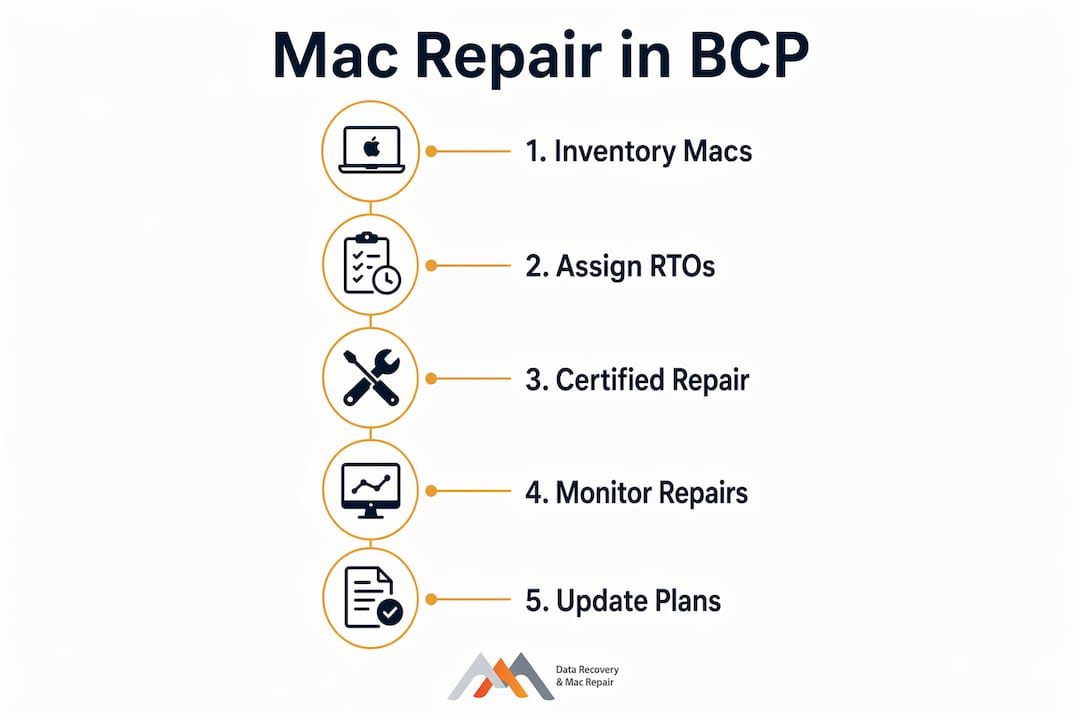
Pro Tip: When drafting your BCP, assign each Mac-dependent business function a specific RTO value and map it to a repair provider’s documented SLA. If your repair vendor cannot commit to same-day turnaround for critical roles, that is a continuity gap that needs to be addressed before a failure occurs.
Why does Apple-certified repair expertise reduce downtime?
The difference between a certified Apple technician and a generalist IT provider is not simply a credential on the wall. Apple-certified repair workflows use proprietary diagnostic tools, Apple System Profiler data, and Apple Configurator 2 protocols that are unavailable to non-authorized shops. These tools identify failure modes at the component level, including T2 security chip faults, SMC irregularities, and APFS container errors, that generic diagnostic software cannot surface.
“Certified technicians undergo Apple training and use proprietary tools; certified repairs protect warranty and data integrity, reducing repeat failures and the downtime they cause.” — MacObserver, ITAM Certification Analysis
The continuity implications of certification extend beyond the repair itself. Consider the following distinctions:
- Warranty preservation: Repairs using non-genuine Apple parts or unauthorized procedures void AppleCare+ and Apple’s Limited Warranty, exposing the organization to full replacement costs on subsequent failures.
- Data integrity: Certified workflows include data protection protocols during logic board and SSD repairs, reducing the risk of APFS volume corruption or FileVault key loss during the repair process.
- Reduced recurrence: Tracking repair provenance and using genuine parts prevents “repair drift,” the gradual degradation of device reliability caused by incompatible components accumulating across multiple non-certified repair events.
- Faster diagnostics: Proprietary Apple diagnostic tools reduce the time from intake to diagnosis, which directly compresses the overall repair cycle and supports tighter RTO compliance.
For organizations running MacBook Pro, iMac, Mac Mini, or Mac Pro fleets, the cumulative effect of non-certified repairs is a device population that becomes progressively less reliable. Each workaround fix introduces a new failure vector. Certified repair eliminates that compounding risk.
Common challenges in Mac repair that threaten business continuity
The most damaging continuity risk in Mac environments is not hardware failure itself. It is the organizational decision to route Mac repairs through Windows-first IT workflows. Generalist IT providers applying Windows-derived diagnostic logic to macOS issues consistently extend resolution times and miss root causes, because APFS, the T2 chip, and Apple Silicon architecture behave fundamentally differently from Windows NTFS and x86 hardware stacks.
| Challenge | Continuity Impact | Recommended Response |
|---|---|---|
| Windows-first diagnosis on macOS failures | Extended resolution time; missed root cause | Engage Mac-native repair provider with Apple certification |
| Workaround repairs without component-level fix | Repeat incidents after macOS updates | Require documented root-cause resolution before device return |
| No repair SLA aligned to BCP RTO | Unpredictable downtime duration | Negotiate SLA with same-day or next-day repair commitment |
| Missing repair provenance records | Warranty voids; untracked failure patterns | Maintain repair log with parts, technician, and date for each device |
| No Mac-native MDM in device lifecycle | Delayed remote triage; slow redeployment | Deploy Jamf Pro or Apple Business Manager for fleet management |
Hidden IT friction costs compound quickly in Mac environments managed by generalist providers. Slow resolutions pull leadership time into troubleshooting. Recurring incidents reduce employee confidence in their tools. Workaround repairs that fail after a macOS update force a second repair cycle, doubling the downtime cost of the original incident. None of these costs appear as a line item in the IT budget, but they are measurable in lost billable hours, delayed deliverables, and staff frustration.
Pro Tip: Audit your last 12 months of Mac repair incidents. If any device required repair for the same issue more than once, that is evidence of a root-cause failure in your repair workflow, not a hardware anomaly. Replace the repair provider before the next incident, not after.
How to integrate Mac repair into your IT continuity plan
A business continuity and disaster recovery (BCDR) plan that does not explicitly inventory Mac systems and their repair dependencies is incomplete. The BCP covers organization-wide operational functions during a disruption. The disaster recovery plan (DRP) targets IT infrastructure restoration after a failure. Mac repair sits at the intersection of both, because a failed MacBook is simultaneously a hardware incident and a business function disruption. Treating it as only one or the other leaves gaps in your recovery model.
To integrate Mac repair readiness into your BCDR framework, address the following elements:
- System inventory: Catalog every Mac device by model, serial number, macOS version, and assigned business function. Flag devices supporting critical functions, such as finance, client delivery, or operations, as high-priority repair assets.
- Vendor dependency mapping: Identify your certified Mac repair provider as a named dependency in the BCP, the same way you would document your cloud backup provider or internet service provider. Include their SLA, contact protocol, and escalation path.
- RTO/RPO alignment: For each Mac-dependent function, confirm that your repair provider’s documented turnaround time meets or beats the RTO defined in your business impact analysis (BIA). Recovery objectives must be validated against actual repair capabilities, not assumed.
- Communication protocols: Define who is notified when a Mac device fails, who authorizes repair, and who tracks the incident through to resolution. Ambiguity in this chain extends downtime.
- Proactive maintenance scheduling: Preventive logic board inspections, battery health checks, and SSD wear assessments reduce unplanned failures. Schedule these on a defined cycle, particularly for devices older than three years running Apple Silicon or Intel architectures.
- Data recovery integration: For failures involving APFS volume corruption, liquid damage, or NAND degradation, your BCDR plan must include a data recovery protocol. Confirm your repair provider can perform on-site or in-lab RAID, SSD, and hard drive data recovery to avoid splitting the incident across multiple vendors.
Organizations that treat Mac repair as an ad hoc IT task rather than a planned continuity control consistently experience longer downtime durations and higher incident recurrence rates. Building repair readiness into the BCDR framework converts Mac repair from a reactive cost into a measurable continuity asset.
Key takeaways
Mac repair is a measurable business continuity control, and its effectiveness depends entirely on the quality, speed, and certification level of the repair provider you choose.
| Point | Details |
|---|---|
| Mac repair aligns with RTO/RPO | Repair SLAs must match BCP recovery targets to prevent function-level downtime. |
| Certified repair reduces recurrence | Apple-certified workflows using genuine parts prevent repair drift and repeat failures. |
| Windows-first IT increases risk | Generalist providers extend resolution times and miss macOS root causes, compounding downtime. |
| BCDR plans must name repair vendors | Mac repair providers should be documented dependencies in your business continuity framework. |
| Proactive maintenance prevents failures | Scheduled inspections of logic boards, batteries, and SSDs reduce unplanned continuity incidents. |
Why I think most businesses underestimate Mac repair as a continuity risk
After working with Mac environments across professional services, creative agencies, and technology firms, the pattern is consistent: organizations invest heavily in cloud backups, redundant internet connections, and cybersecurity tools, then route Mac hardware failures through whoever is available. That mismatch is where continuity plans quietly fail.
The hidden cost is not the repair invoice. It is the three hours a senior designer spends on a loaner machine that cannot run their licensed Adobe Creative Cloud plugins, or the account manager whose MacBook Pro is returned after a “fixed” kernel panic that reappears two weeks later because the underlying NVMe controller degradation was never diagnosed. These are not edge cases. They are the predictable outcome of treating Mac repair as a commodity service.
My recommendation is to evaluate your repair provider the same way you evaluate any other continuity vendor: with documented SLAs, certified technician credentials, and a clear protocol for root-cause reporting. If your current provider cannot tell you what component failed, why it failed, and what was done to prevent recurrence, you are not buying repair. You are buying temporary relief. For organizations where Mac devices support revenue-generating functions, that distinction matters more than the repair cost itself.
The repair checklist for Mac users is a practical starting point for evaluating whether your current repair workflow meets continuity standards.
— Kaya
How Macwestlosangeles supports your business continuity
Macwestlosangeles has provided Apple-certified Mac repair and data recovery services from its Wilshire Boulevard location in Los Angeles since 2006, serving businesses across West LA, Santa Monica, Beverly Hills, Brentwood, Westwood, and Culver City. The team handles MacBook, iMac, Mac Mini, and Mac Pro repairs at the component level, including logic board microsoldering, liquid damage remediation, SSD and RAID data recovery, and screen and battery replacements.
For business clients, Macwestlosangeles offers same-day appointments, free diagnostics, and a no-recovery, no-charge policy on data recovery cases. Every Mac repair service uses genuine Apple parts and certified workflows to preserve warranty coverage and prevent repeat failures. If your organization needs a repair partner whose SLA can be written into your BCP, call Macwestlosangeles at 310-866-0828 or visit the office at 12041 Wilshire Blvd, Ste 26, Los Angeles.
FAQ
What is the role of Mac repair in business continuity?
Mac repair is a direct continuity control that determines whether a business meets its Recovery Time Objective (RTO) when an Apple device fails. Timely, root-cause repair by a certified technician restores the affected business function within the defined recovery window, preventing cascading operational disruption.
How does Apple certification affect repair quality and downtime?
Apple-certified technicians use proprietary diagnostic tools and genuine parts that non-certified providers cannot access, reducing both resolution time and the likelihood of repeat failures. This directly supports continuity by keeping devices reliable across their full operational lifecycle.
Why do Windows-first IT providers increase Mac downtime risk?
Windows-first diagnosis applied to macOS failures misses root causes specific to APFS, Apple Silicon, and the T2 security chip, extending resolution times and producing workaround repairs that fail after macOS updates. Each repeat incident adds unplanned downtime that degrades your continuity record.
How should Mac repair be included in a BCDR plan?
Your BCDR plan should inventory all Mac devices by function and priority, name your certified repair provider as a documented vendor dependency, and confirm that the provider’s SLA meets the RTO assigned to each Mac-dependent business function in your business impact analysis.
What Mac repair services does Macwestlosangeles offer for business clients?
Macwestlosangeles provides same-day Mac repair and hard drive data recovery for MacBook, iMac, Mac Mini, and Mac Pro systems, covering logic board repairs, liquid damage, SSD and RAID recovery, and battery and screen replacements, with free diagnostics and no-recovery, no-charge data recovery from its Los Angeles location.