TL;DR:
- Immediately stop all SAN disk writes to prevent further data loss.
- Logical failures like corrupt LUNs or deleted volumes can be recovered with quick expert intervention.
Stop all disk writes immediately. SAN data recovery is the process of restoring lost, deleted, or inaccessible block-level data from a Storage Area Network, where storage is presented to servers as logical units called LUNs rather than as individual drives. Unlike a single hard drive or NAS device, a SAN pools multiple disks across RAID groups (0, 1, 3, or 5), controller hardware, and LUN abstraction layers, so a single failure can cascade across VMs, databases, and applications at once. Isolate the SAN, preserve drive order, and do not touch the controller interface until a specialist has assessed the situation.
SAN recovery differs fundamentally from standard drive or NAS recovery because the failure chain is multi-layered. A corrupted LUN may look like a physical disk failure, but the actual cause could be firmware corruption, a RAID controller fault, or a bad metadata write during a volume expansion. Attempting to rebuild the array through the SAN’s management interface can overwrite RAID metadata and make professional recovery impossible.
Failures split into two categories with very different outlooks:
- Logical failures (corrupt LUNs, deleted volumes, APFS file-system damage, accidental reformats) carry a high recovery rate when a specialist intervenes quickly with low-level read-only tools.
- Physical failures (controller board failure, NVMe or SSD media damage, power surge) require sector-level imaging before any reconstruction begins.
Pro Tip: Never save recovered files back onto the original SAN volume. Export to a separate, verified device to avoid overwriting the evidence the lab needs.
Table of Contents
How Macwestlosangeles Handles SAN and RAID Recovery in Los Angeles
Macwest Data Recovery & Mac Repair has served Los Angeles since 2006, handling RAID and SAN recovery for businesses and individuals across West LA, Santa Monica, Beverly Hills, Brentwood, Westwood, Venice, Hollywood, and Culver City. The lab is centrally located at 12041 Wilshire Blvd, Ste 26, between the 405 and Santa Monica, near UCLA and the Getty Center.
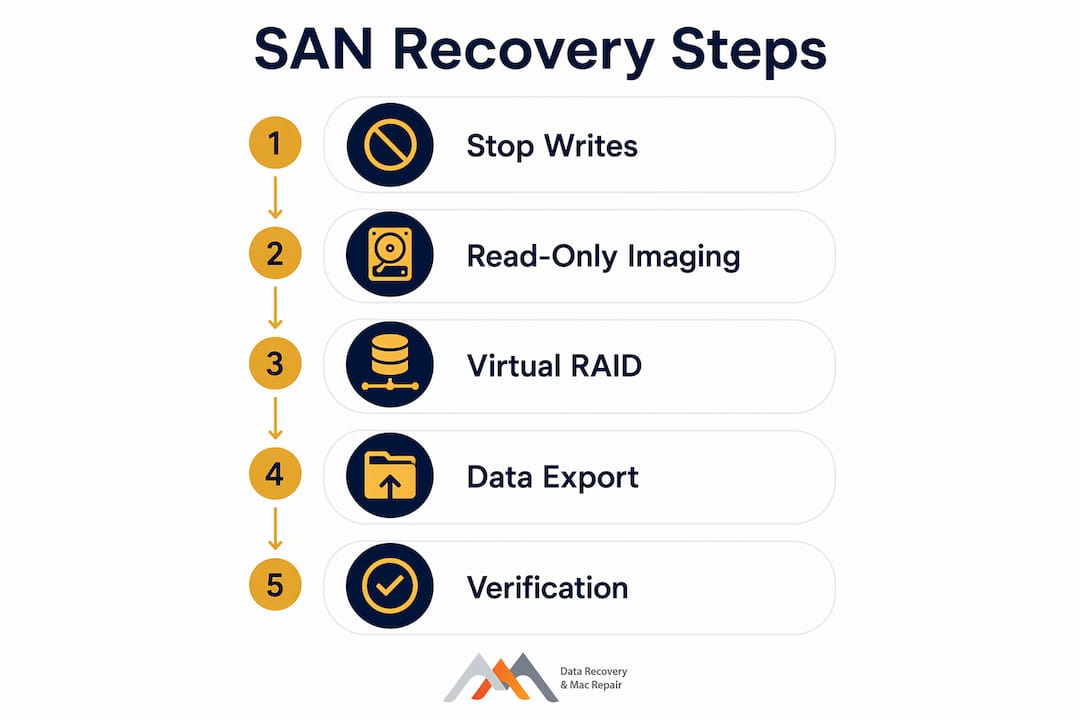
The recovery workflow follows a staged, forensic approach:
- Secure intake with chain-of-custody documentation and restricted lab access
- Sector-level imaging of every drive member before any reconstruction, prioritizing unstable media
- Virtual RAID/LUN reconstruction, determining stripe size, parity rotation, disk order, and any snapshot or thin-provisioning layers
- File-system repair, including APFS containers, CoreStorage, and VMFS/VMDK cases for Mac-hosted VMs
- Integrity verification of recovered files before delivery
- Encrypted, secure delivery to alternate storage, never back to the original volume
Macwestlosangeles offers free diagnostics and a no-recovery, no-charge policy. Same-day and emergency appointments are available for urgent SAN incidents. Call 310-866-0828 or visit the data recovery service page to book.
Failure type vs. recovery prospects
| Failure type | Common causes | Typical recovery outlook |
|---|---|---|
| Logical | Corrupt LUN, deleted volume, APFS damage | High, when handled quickly in read-only mode |
| Physical | Controller failure, NVMe/SSD media damage | Moderate; depends on imaging success |
| Mixed (logical + physical) | Power surge, firmware corruption + disk failure | Variable; staged lab process required |
When to call immediately: multiple drives offline, controller not recognizing LUNs, VMs inaccessible, or any RAID rebuild prompt appearing on screen. If backups are intact and only one non-critical volume is affected, verify the backup first before calling.
FAQ
What exactly is SAN data recovery?
SAN data recovery restores block-level data from a Storage Area Network after logical or physical failure. It covers corrupted LUNs, deleted volumes, RAID degradation, and controller faults across shared storage pools.
Should you attempt a RAID rebuild yourself after a SAN failure?
No. Rebuilding through the SAN interface can overwrite LUN metadata and permanently destroy recovery chances. Isolate the system and contact a specialist first.
How long does professional SAN recovery take?
Timelines vary by failure complexity. Logical recoveries often complete within one to three business days; physical or mixed failures requiring sector imaging and virtual reconstruction typically take longer depending on drive count and media stability.
What does SAN recovery cost in Los Angeles?
Costs depend on failure type, drive count, and RAID configuration. Macwestlosangeles provides free diagnostics with no charge if recovery is unsuccessful, so you know the scope before committing.
What is the difference between SAN, NAS, and direct-attached storage?
A SAN uses block-level storage presented as LUNs over a dedicated high-speed network; NAS uses file-level storage over Ethernet; DAS connects directly to one host. SAN recovery is the most complex of the three because of RAID metadata, controller abstraction, and LUN mapping layers.
Key Takeaways
SAN data recovery requires immediate containment, read-only imaging, and virtual RAID reconstruction by a specialist — DIY rebuilds destroy the metadata labs need to restore your data.
| Point | Details |
|---|---|
| Stop writes first | Isolate the SAN and preserve drive order before touching any controller interface. |
| Logical failures recover well | Corrupt LUNs and deleted volumes carry a high recovery rate when a specialist acts quickly. |
| Physical failures need imaging | Controller or NVMe damage requires sector-level imaging before any reconstruction attempt. |
| Never rebuild without diagnosis | Initiating a RAID rebuild through the SAN interface can permanently overwrite recovery metadata. |
| Macwestlosangeles, Los Angeles | Free diagnostics, no-recovery-no-charge policy, and same-day appointments at 310-866-0828. |