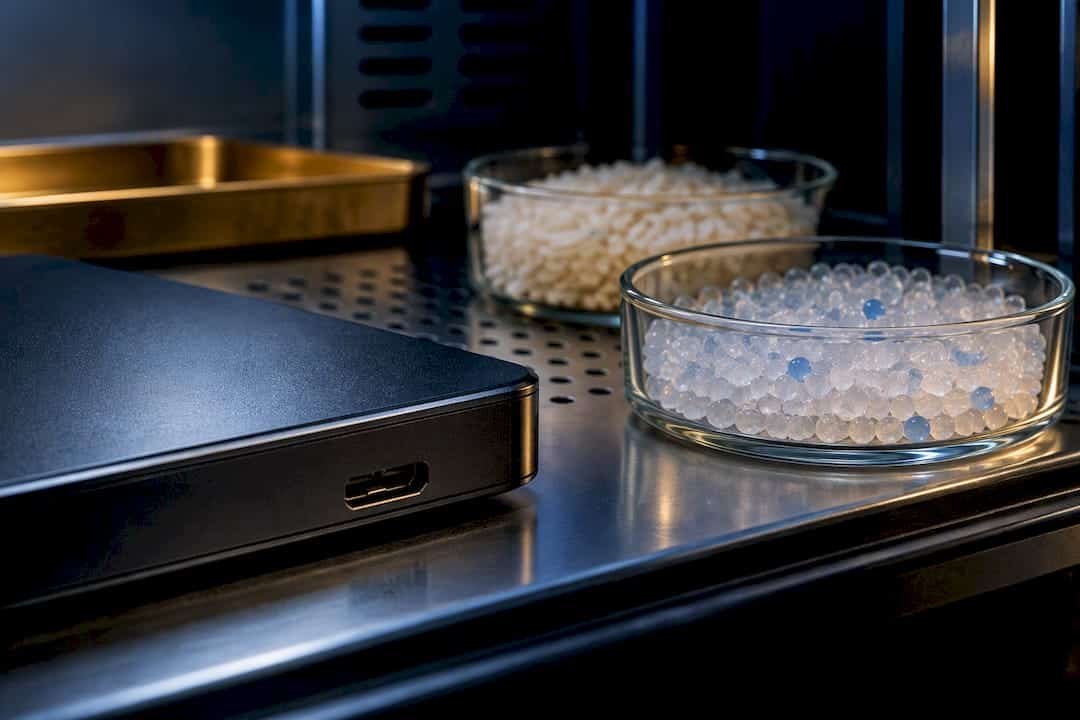
Silica gel wins the rice vs silica gel comparison for nearly every real-world drying task, from stored camera gear to hearing aids to a damp filing cabinet. Lab testing shows silica gel adsorbs moisture faster and more predictably than rice, and it can be reused after a simple oven bake. Rice can lower ambient humidity in a sealed container of small, low-value items when no silica is on hand, but it is not a repair method. Stop all disk writes immediately if the item in question is a hard drive, SSD, or phone holding data you cannot lose. No amount of rice, silica gel, or patience fixes a logic board that has already corroded.
TL;DR:
- Silica gel adsorbs moisture faster, more predictably, and can be reused after recharging at high temperatures, making it ideal for long-term storage.
- Rice’s moisture absorption varies significantly by variety and test conditions, and it takes much longer to lower humidity compared to silica gel.
- Using rice is only suitable as a temporary, low-cost humidity barrier for small, sealed, low-value items, never as a repair method for electronic devices.
- Neither rice nor silica gel can fix devices that are already corroded or have trapped liquid damage; powering on wet electronics risks further harm.
- Proper drying requires airtight sealing, adequate desiccant volume, and sufficient time, with silica gel being more reliable and safer for repeated use.
Table of Contents
- Rice vs Silica Gel: Comparing Adsorption Capacity, Speed, and Safety
- Why Silica Gel Outperforms Rice at the Molecular Level
- How to Use Silica Gel and Rice Correctly (Step by Step)
- What Desiccants Cannot Fix, and How to Handle Safety Risks
- When Moisture Damage Needs Professional Repair, Not a Rice Bag
- Rice vs Silica Gel at a Glance
- The Rice Myth Won’t Die, and That’s the Real Problem
- Sources
- FAQ
Rice vs Silica Gel: Comparing Adsorption Capacity, Speed, and Safety
The numbers tell a clear story once you get past the folk wisdom. Silica gel is a manufactured desiccant engineered for one job: pulling water vapor out of the air and holding onto it. Rice is a food product that happens to be somewhat hygroscopic, which is a different thing entirely.
Research from the University of Arkansas on drying post-harvest rough rice found that silica gel could pull moisture out of grain efficiently, and a rice-to-silica-gel mass ratio of roughly 3 to 1 brought rough rice down to target moisture levels within 12 to 48 hours. That study also measured silica gel’s own capacity, and separate lab work on synthesized silica gel found uptake in the range of about 10.56% to 11.20% of its own weight under controlled conditions, with some formulations adsorbing up to roughly 40% of their weight at full saturation. Those figures move around depending on the bead formulation, the humidity level, and how long the test runs, so treat any single percentage as a snapshot, not a universal constant.
Rice tells a messier story. A study on medium-grain rice varieties using dynamic vapor sorption found that rice follows what’s called a Type II sorption isotherm, and that different rice varieties absorb moisture at meaningfully different rates, with equilibration times and moisture hysteresis that vary by test method and variety. In plain terms, rice does not absorb water at one fixed rate. It depends on which rice you use, how dry the room is, and how long you’re willing to wait.
Here’s where the comparison gets genuinely interesting: one clinical study testing uncooked white rice against several commercial silica desiccants for drying hearing aids found that rice performed statistically similar to some of the silica products in that specific test setup. That result surprises a lot of people, and it’s the closest thing to scientific backing the “rice trick” has ever gotten. But a hearing aid is a tiny, low-mass device tested under narrow lab conditions. It says nothing about how rice performs on a MacBook logic board, a saltwater-soaked iPhone, or a hard drive platter.
Silica gel also holds up better over time. A 2021 study on preserving environmental DNA samples found silica gel desiccation kept samples viable at room temperature longer than ethanol storage, and it outperformed ethanol at warmer temperatures over extended periods, showing its stability for long-term moisture control, according to research on eDNA preservation methods. That’s a different application, but it demonstrates the same underlying property that matters for your camera bag or gun safe: silica gel maintains a stable, low-humidity environment for months, not hours.
Side by side, the practical differences break down like this:
- Adsorption capacity: Silica gel commonly reaches 10% to 40% of its own weight in moisture, test-dependent; rice’s equilibrium uptake runs lower and varies by variety.
- Speed: Silica gel lowers relative humidity faster and more consistently; rice needs longer, unpredictable dwell time.
- Reusability: Silica gel regenerates with heat; rice cannot be dried out and reused as a desiccant.
- Safety and contamination: Rice can shed starch dust and attract pests; silica gel is inert but some indicating beads carry their own handling notes.
- Cost: Rice is cheaper per pound, but you need a lot more of it, and it can’t be recharged, so the lifetime cost favors silica gel for anything you store repeatedly.
Why Silica Gel Outperforms Rice at the Molecular Level
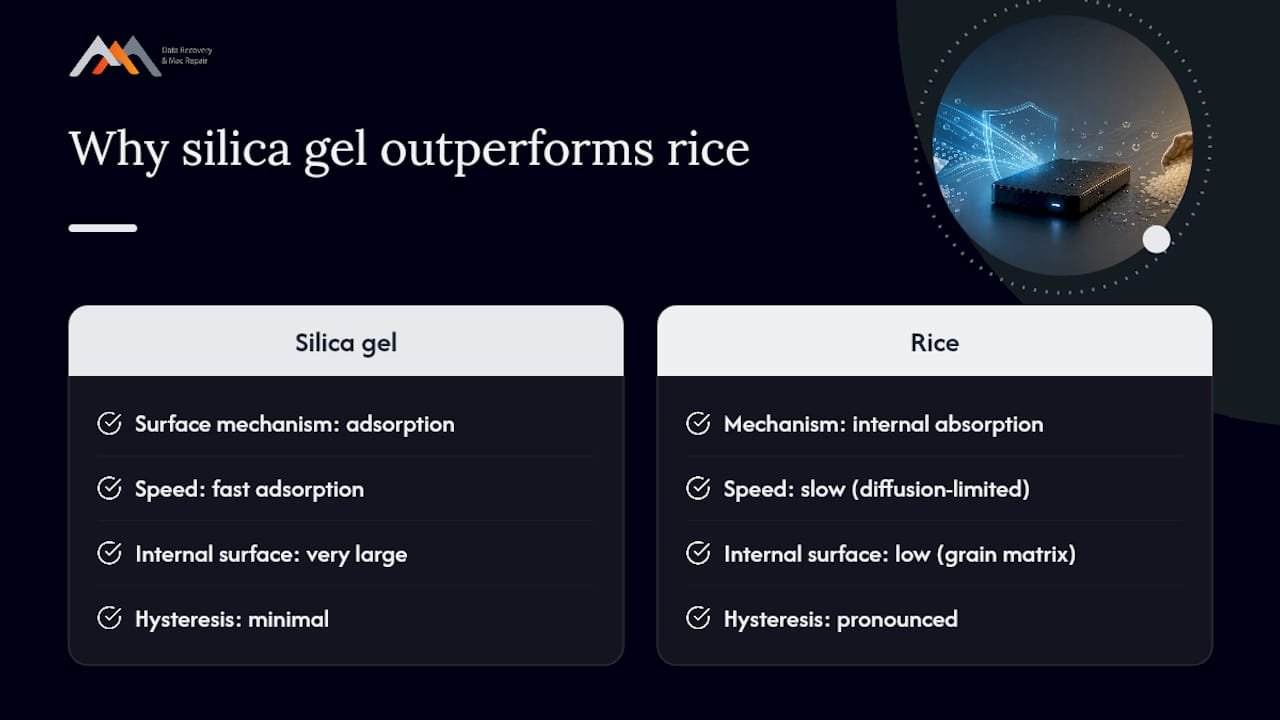
Silica gel is amorphous silicon dioxide riddled with microscopic pores, and that porous structure is the whole trick. Water vapor molecules stick to the enormous internal surface area inside each bead through a process called adsorption, where moisture clings to the surface rather than soaking into the material itself. Because the process happens at the surface, it can happen fast, and manufacturers can tune bead size, pore structure, and coating to hit a target adsorption rate for a given humidity and temperature range.
Rice works through a completely different mechanism. Grain kernels contain starch, protein, and a husk layer, and moisture moves into and out of that structure through absorption, not surface adsorption. Water has to migrate through the grain’s internal matrix, which is inherently slower and less consistent than clinging to a porous bead’s surface. That’s the physical reason rice shows the Type II sorption isotherm and hysteresis pattern documented in vapor sorption testing: the rate at which rice picks up or releases moisture depends on which direction it’s moving from, and different rice varieties show meaningfully different curves.
This matters more than it sounds. A sorption isotherm hysteresis means rice can appear to have dried an item on the surface while retaining moisture internally, and it may release that moisture back into a sealed container later once conditions shift. Lab data on dynamic vapor sorption for medium-grain rice varieties found equilibration behavior that differed depending on whether researchers used dynamic vapor sorption or saturated salt solution testing methods, which is a fancy way of saying: the exact same rice can test differently depending on how you measure it.
None of this means rice is useless. It means the “percent moisture removed” figure people quote online rarely specifies test temperature, relative humidity step, sample-to-desiccant mass ratio, or equilibration time, and every one of those variables changes the answer. A single number pulled from one lab test under one set of conditions is not a promise about your bathroom-humid camera bag or your kid’s phone that fell in a pool.
How to Use Silica Gel and Rice Correctly (Step by Step)
Using either desiccant properly comes down to three things: enough desiccant mass, an airtight seal, and enough time. Skip any one of those and you’re just storing a damp item next to some rice or beads and hoping.
- Choose indicating silica gel packets when you can. Color-changing beads (often shifting from orange to green, or blue to pink depending on the brand) tell you at a glance when the packet is saturated and needs replacing or recharging.
- Match desiccant volume to the sealed space, not just the item. A small sealed box or dry bag holding a camera or phone typically needs several 5 to 10 gram packets, scaled up for larger enclosures or higher ambient humidity.
- Seal the container completely. A loosely closed bag lets humid air keep replacing the air you just dried. Vacuum-sealed bags or airtight hard cases work far better than a sandwich bag or open bin.
- Give it real time. The Arkansas rice-drying research found even a favorable 3:1 desiccant ratio took 12 to 48 hours to hit target moisture levels. A phone or camera in a sealed bag with silica packets needs at least 24 to 48 hours, not the “overnight” timeline that gets repeated online.
- Regenerate silica gel in the oven once it’s saturated. Most consumer beads recharge at temperatures above 100°C (check your specific product’s instructions, since some formulations have lower thresholds), spread on a baking sheet for an hour or two until the indicator color returns to “dry.”
- Use rice only as a last resort, and only for small, sealed, low-value items where ambient humidity control (not device repair) is the goal. Dry, uncooked white rice in a sealed container can modestly lower humidity around a damp wallet, a fogged lens, or a musty drawer. It is slow, it varies by rice type, and it introduces starch dust and pest risk that silica gel doesn’t carry.
- For any powered device that got wet, skip both. Power it off immediately. Pull the battery if it’s removable. If it’s a storage drive, stop writing to it entirely. Do not repeatedly try to power it on to “check if it’s working,” and do not put a phone or laptop in a bag of rice and call that a repair plan.
Pro Tip: Keep a stash of pre-charged, indicating silica gel packets in your camera bag, gun safe, and filament storage boxes year-round. Reactive drying after a spill is always worse than passive humidity control that’s already in place.
For anything that touched liquid and holds data, the safest habit is to treat drying and data recovery as two separate problems. Moisture control might save the hardware. It does nothing to protect a corrupted SSD that’s still receiving write commands, and it does nothing to prevent hidden corrosion under a shielded chip. That’s a job for proper liquid damage inspection, not a bag of Jasmine rice.
What Desiccants Cannot Fix, and How to Handle Safety Risks
Neither rice nor silica gel repairs a wet device. Desiccants remove water vapor from the air around an object. They do nothing for liquid that’s already pooled under a battery, trapped inside a connector, or sitting on a logic board where it’s actively causing corrosion. Drying the surrounding air doesn’t reverse chemical damage that’s already started, and by the time you notice a device acting strange, that damage may already be underway.
Powering a wet device back on repeatedly is one of the most damaging things you can do. Each power cycle sends current through circuits that may still have moisture bridging contacts, which can turn a recoverable short into permanent board damage. For anything holding photos, documents, or business files, treat “drying in rice” as a delay tactic at best, never as a recovery method. Rice cannot pull moisture out from underneath a shielded SSD controller, and neither can silica gel, for that matter. A desiccant only works on vapor it can actually reach.
A few safety notes worth knowing before you reach for silica gel packets:
- Indicator chemistry matters. Some older indicating silica gels use cobalt dichloride to trigger the color change, and a survey of desiccants used in diagnostic test kits found that indicator design and disposal instructions are often incomplete on consumer packaging.
- Dispose of old indicating packets properly rather than tossing them in general trash if the packaging flags a cobalt-based indicator; look for silica-only or moisture-card alternatives where available.
- Never eat or open silica packets, despite the “do not eat” warning being widely ignored; the silica itself is generally inert, but indicator dyes are not meant for ingestion.
- Call a professional the moment you see visible liquid intrusion, a device that won’t boot, or a drive holding data you can’t lose. Waiting to see if drying helps often costs more time than it saves.
When Moisture Damage Needs Professional Repair, Not a Rice Bag
Professional data recovery and repair services show a consistent pattern: the devices that come back fully working are the ones that stopped getting used the moment they got wet. The ones that don’t recover are almost always the ones someone tried to dry out and power back on two or three times first.
Professional inspection starts where desiccants stop. Some repair services offer free diagnostics on Mac hardware and data recovery cases, and work on a no recovery, no charge basis, so customers are not paying to find out a drive isn’t recoverable. For moisture and liquid damage specifically, that means:
- Board-level micro-soldering and logic board component repair for corrosion damage under BGA chips and connectors that no amount of drying reaches.
- ISO Class 5 cleanroom imaging for drives where platters or NAND need to be accessed without introducing contamination, relevant for APFS-formatted SSDs and traditional spinning drives alike.
- RAID and NVMe recovery workflows for business-grade storage, including RAID 0, 1, 3, and 5 arrays that failed during a flood or leak event.
If a device took on water and holds anything you can’t afford to lose, stop disk writes immediately and get it inspected before trying anything else. Macwest serves West LA, Santa Monica, Beverly Hills, Brentwood, Westwood, Venice, Hollywood, and Culver City from a central lab at 12041 Wilshire Blvd, Ste 26, between the 405 and Santa Monica, near UCLA and the Getty Center. Same-day appointments may be available for urgent cases. Contact professional services promptly to get a device evaluated before more damage sets in.
Rice vs Silica Gel at a Glance
| Factor | Silica Gel | Rice |
|---|---|---|
| Adsorption capacity | ~10% to 40% of weight, formulation and test-dependent | Lower and variable, dependent on rice variety |
| Speed | Faster, more predictable RH reduction | Slower, with hysteresis and equilibration lag |
| Regenerability | Yes, oven-recharge above 100°C | No, cannot be dried and reused reliably |
| Contamination risk | Low, though some indicators use cobalt dichloride | Higher: starch dust, pest attraction |
| Best suited for | Electronics, cameras, storage, sensitive samples | Small, low-value items when no silica is available |
One figure worth remembering: the University of Arkansas drying study found a 3:1 rice-to-silica-gel mass ratio brought rough rice to target moisture within 12 to 48 hours, a timeline far longer than the “overnight fix” reputation rice has picked up online.
Three takeaways worth acting on: silica gel is faster and reusable, so it belongs in any ongoing storage setup. Rice is a stopgap for ambient humidity around small, cheap items, never a repair tool. And for anything electronic or data-bearing, the desiccant question is secondary to shutting the device down immediately.
The Rice Myth Won’t Die, and That’s the Real Problem
The rice trick survives because it occasionally seems to work, and that’s exactly what makes it dangerous. A phone dried in rice for two days sometimes powers back on fine, and the person doing it walks away convinced they found a cheap fix. What they usually don’t see is the slow corrosion building under a connector that finally fails three months later, or the drive that boots today and drops sectors next week.
The hearing-aid study gets cited constantly as proof rice “works,” and it’s a real, useful finding within its scope. But a hearing aid is small, cheap, and easy to test repeatedly. A MacBook logic board or a NAND-based SSD is neither. The conventional advice treats all wet electronics as one problem with one folk solution. They’re not. Vapor removal and liquid damage repair are separate problems, and conflating them is how a $30 phone becomes a $0 phone.
If you take one thing from the evidence here, take this: reach for silica gel for anything you’re storing long-term, and reach for a professional the second something powered actually got wet.
— Kaya
Sources
- Drying of post-harvest rough rice with silica gel: A preliminary investigation
- The effectiveness of commercial desiccants and uncooked rice in removing moisture from hearing aids
- Silica gel beads as an alternative to ethanol for preserving environmental DNA on filters
- Dynamic vapor sorption isotherms of medium grain rice varieties
FAQ
Can I use rice instead of silica gel?
For small, low-value items in a sealed container, rice can modestly lower ambient humidity when no silica gel is available. It’s slower and less consistent than silica gel, and one study found it performed similarly to some commercial silica desiccants specifically for drying hearing aids, a result that doesn’t extend to phones, laptops, or storage drives.
Does rice actually draw out moisture?
Yes, rice absorbs some ambient moisture through its starch structure, but research on medium-grain rice varieties shows the rate varies significantly by variety and test method. It works far more slowly than a purpose-made desiccant.
Does rice act as a dehumidifier?
Rice can reduce humidity inside a small, sealed container over time, similar in principle to a passive desiccant, but nowhere near the capacity or speed of silica gel. Silica gel formulations have shown uptake as high as roughly 40% of their own weight in controlled lab conditions, a scale rice does not reach.
Does putting electronics in rice really work?
It’s an unreliable, unproven repair method for anything electronic. Rice removes some surface-level ambient moisture but cannot reach liquid trapped under shields or inside connectors, and repeatedly powering a wet device back on to test it raises the risk of permanent corrosion damage. If a device holds important data, stop disk writes immediately and seek professional liquid damage inspection instead.
Is silica gel better than rice for storage?
Yes, for ongoing storage of cameras, electronics, or sensitive materials, silica gel is the better choice because it adsorbs moisture faster, can be recharged in an oven, and maintains a stable low-humidity environment for months at a time, as shown in research on silica gel’s sample preservation performance.